

If you’ve ever struggled to find the right size springform pan for your recipe, you’re not alone. Knowing the exact measurements is key to getting your baking just right and ensuring your dessert turns out perfectly.
In this guide, you’ll learn simple, accurate methods for measuring your pan’s size, depth, and capacity so you can bake with confidence.
Keep reading to master these easy steps and take the guesswork out of your baking supplies.
Measure the Inside Diameter at the Top Opening
To measure your springform pan’s inside diameter at the top opening, place the pan on a flat surface and position a ruler straight across from the inner edge to the inner edge. Make sure the ruler is level to get an accurate measurement. Avoid including the pan’s lip, clasp, or outer wall, as these can overstate the true size. Measure directly through the center of the opening for the most precise inside diameter. Record this measurement in inches or centimeters; this is the number recipes use to ensure you select the correct pan size. Most pans are labeled as 8-inch or 10-inch, but verifying your specific pan’s measurement guarantees accuracy. For best results, clean the pan beforehand using baked-on residue removal techniques to ensure no debris interferes with the ruler placement.

FOOD GRADE & NONSTICK COATING: Made from 0.4mm carbon steel with a food-grade nonstick surface, this spring form pan for cheesecake ensures clean release and reliable baking. Ideal as a cheese cake pan for smooth, consistent cheesecake and baking results.

Leak-Resistant Design for Reliable Baking: RFAQK Springform Pan 8 inch of size features a secure stainless steel buckle and tight seal to prevent leaks with thick cake batters like cheesecake. While not fully watertight for thin liquids or water baths, it delivers dependable performance for everyday baking.

Perfect for cheesecake, mousse, quiche and more, this 8 inch springform pan is an essential item in any baker’s kitchen
Measure Springform Pan Depth Without Tilting the Ruler
To measure the depth of your springform pan accurately without tilting the ruler, place the pan on a flat, stable surface. Insert a ruler straight down into the interior until it touches the bottom, ensuring it remains perpendicular to the base. Avoid tilting the ruler to match the sloped sides, as this will distort the reading. Start your measurement from the lowest point of the inner floor, not the exterior base, to get the true usable depth. Measure up to the top of the inner wall or lip, not the outer edge. Keep your eye at the level of the ruler to prevent parallax errors and ensure an accurate reading. If the pan’s base feels uneven, take measurements at multiple points to find the true depth. For consistent results, consider using a nonstick baking surface like a silicone baking mat to level the pan’s base during measurement. Use a rigid metal ruler or caliper for best precision when measuring depth just as accuracy matters for food scales when weighing meat. A tape measure held vertically can also work. Always record your measurement in the same unit and round only after confirming the exact reading. For greater accuracy, consider using a KitchenAid mixer attachment to secure the pan, but only if you own a compatible stand mixer.
Measure the Pan Fully Assembled for Accurate Width
To measure the width of your springform pan accurately, always do it with the pan fully assembled and locked in place. Ensure the clasp and band are in the same position you use during baking. A loose or partially assembled pan can shift, leading to an incorrect measurement. Use the inside edge to inside edge, across the top opening, to avoid including the lip or band width in your measurement. If your pan has side handles, measure across the main body, excluding the handles, to get the true interior width. Record this measurement in inches or centimeters, including any fractional parts, as this is the size you’ll need for recipe matching and baking accuracy.

This 9 inch springform pan accommodates standard size recipes

Multi-Purpose: The well-designed 9-inch springform pans are ideal choices for making cheesecake, quiche, mousse, deep dish pizza, smash cakes, various pies, cookies, and is also the best tool for DIY desserts, allowing you to enjoy your baking time

BUILT TO LAST: This springform pan’s heavy-duty construction resists warping and heats evenly to brown beautifully and help reduce hot spots
Use Water to Estimate Your Pan’s True Capacity
To accurately measure your pan’s capacity, the best method is to use water. Start by lining the pan with a plastic bag or silicone liner to prevent leaks. Level the water surface to ensure an accurate reading. Tare the empty pan on your digital kitchen scale so it reads zero. Fill the pan with water until it reaches the top. Record the weight in grams—each gram equals one milliliter. To convert this to cups, divide the number of milliliters by 237; for liters, divide by 1,000. The four standard sizes for measuring cups are 1 cup, ½ cup, ⅓ cup, and ¼ cup. This water-based measurement method provides a precise capacity, especially useful for nonstandard shapes or sizes. For baking, note that dry measuring cups are designed to be filled level, while liquid measuring cups have a spout and markings for volume. Unlike cookware coatings that may vary in heat resistance depending on color, this method relies purely on volume.

Round Silicone Springform Pan Protector for Cheesecake Water Bath : Silicone springform pan protector keeps all the water out and helps you successfully make moist and creamy cheesecake.

♥ Less stress & Mess Free: Silicone baking mat make you Spring form Pan clean like new each time. Less your Stress and Mess Free

Cake Release Effortless: Springform pans silicone mat prevent cake from Sticking to bottom and side, Effortless Cake Release
Match Your Measurements to Recipe Requirements
Start by matching your pan’s diameter to the recipe’s requirement. A 9-inch springform pan is standard for cheesecakes, while a 10-inch pan suits larger desserts. Depth is just as important; most recipes assume a 2.5-inch pan height. Measure your pan accurately to ensure the batter fits, preventing overflow or a thin crust. The material of the pan also influences the outcome; lighter metals conduct heat more quickly, which can affect baking time and texture. For optimal results, a half sheet pan offers a flat, even surface that complements the precision needed for cake layers. Handles that protrude may interfere with your oven rack or skew the measurement of the pan’s true diameter. To adapt the recipe’s batter, match your pan’s capacity— a 9-inch by 2.5-inch pan holds roughly 10 cups, while a 10-inch by 2.5-inch pan holds about 12 cups. Also, consider the dessert type—cheesecakes, quiches, and tortes all depend on precise dimensions for optimal results. For the most accurate volume measurement, fill your pan with water and pour it into a measuring cup to find the exact capacity. Using parchment paper cut to fit the bottom can further prevent sticking and simplify release.

Superior Materials🥘 The springform pan is made of high-strength, high-carbon steel, which is highly durable and has a strong load-bearing capacity. It is not easily deformed or cracked even after prolonged high-temperature baking. The surface is treated with rust prevention, making it corrosion-resistant, wear-resistant, and with a longer service life

Leak-Resistant Design for Reliable Baking: RFAQK 9 inch Springform Pan features a secure stainless steel buckle and tight seal to prevent leaks with thick cake batters like cheesecake. While not fully watertight for thin liquids or water baths, it delivers dependable performance for everyday baking.
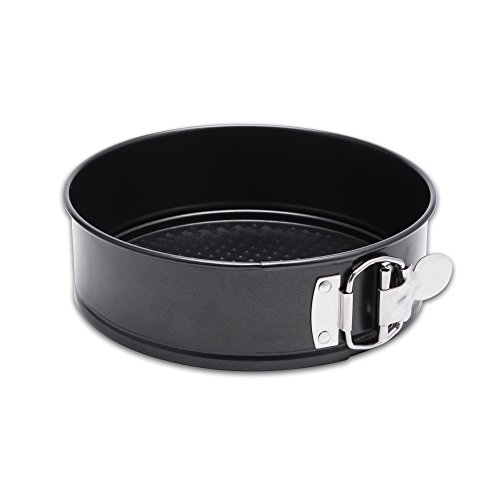
HEALTHY COATING: Our Non-stick coating is a food grade safety coating with no harsh chemicals or hazardous substances. The true double layer coating allows the cake be easily removed without damage. Avoid making it difficult to clean the cake because it sticks to the pan or leaves a lot of cake residue.
Avoid Common Measurement Mistakes That Ruin Your Bake
To ensure your springform pan measures correctly, focus on measuring the inside diameter, not the outer rim. Use a ruler placed straight across from inner edge to inner edge, avoiding the lip, clasp, or rolled edge. This measurement determines your actual baking surface, which is crucial for recipe accuracy. Remember, the pan’s material influences heat distribution but doesn’t affect how you measure its size. Additionally, measure the height from the bottom to the top of the rim, not including any exterior hardware. This height affects your recipe’s depth and volume, especially when cake layers or fillings are involved. Be aware that two pans labeled as 9 inches in diameter may differ in true interior size; always verify with an actual measurement. For the most accurate results, close the ring before measuring to prevent inaccuracies that can lead to uneven baking or texture issues. For placement on a heated surface, consider using a top heat resistant mat to protect your countertop from the pan’s conducted heat. When lining the pan with parchment, proper prep prevents sticking by ensuring the liner fits the measured interior surface exactly. For easier cleanup, consider using non-stick baking tray care methods to keep your pan residue-free.