

Ever wonder how many sizes of dry measuring cups you really need? Most recipes call for just four common sizes: 1 cup, ½ cup, ⅓ cup, and ¼ cup. Knowing how these fit together can make your cooking and baking much easier.
Keep reading to learn about the sizes, their equivalents, and the key differences that help you measure accurately every time.
1 Cup, ½ Cup, ⅓ Cup, and ¼ Cup: The Standard Dry Measuring Set
Most dry measuring cup sets include four sizes: 1 cup, ½ cup, ⅓ cup, and ¼ cup. These cater to the most common recipe fractions, from full cups down to smaller, precise amounts. Usually, they come as nesting sets, making storage simple and space-efficient. For those seeking maximum precision, a high-quality food scale can eliminate the inconsistencies of dry measuring entirely. Just as with specialized bakeware, investing in well-made measuring tools can improve your baking results. A similar principle applies when using a standard cake pan instead of a springform pan for cheesecake.
When selecting your set, consider the material—glass versus plastic. Glass feels heavier and won’t absorb odors, making it durable over time. Plastic is lighter and less likely to break if dropped. An ergonomic handle design is important; a comfortable, non-slip grip helps you level off ingredients accurately. The 1-cup piece typically serves as the anchor, with clear markings on the handle or body for quick identification. The 1/3-cup size fills a useful gap between 1/4 and 1/2 cup, allowing you to measure a wider range of recipe ingredients precisely.
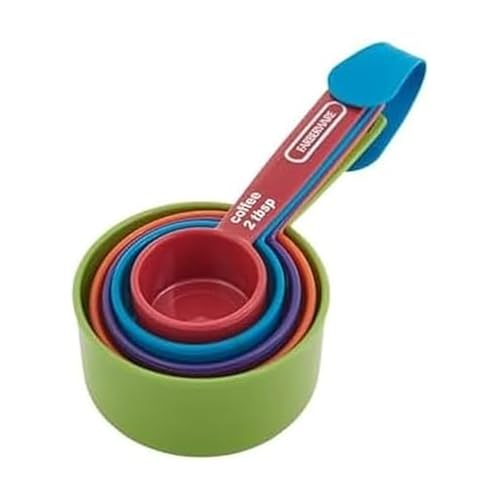
COMPLETE MEASURING SET: Includes 1/4 cup, 1/3 cup, 1/2 cup, and 1 cup measurements plus bonus coffee scoop (2 tablespoons). Perfect for both wet and dry ingredients. Clearly marked measurements for precise cooking

A 4‑piece stoneware measuring cup set with ribbed batter bowl design in vibrant colors

COMPLETE 12-PIECE SET: Includes 6 measuring cups (1/4, 1/3, 1/2, 2/3, 3/4, and 1 cup) and 6 measuring spoons (1/8 tsp, 1/4 tsp, 1/2 tsp, 1 tsp, 1/2 tbsp, 1 tbsp) - everything needed for cooking and baking
Learn the Exact Ounce and Milliliter Equivalents for Each Size
A standard US cup equals 8 fluid ounces and approximately 236.588 milliliters. This measurement is considered precise for most cooking and baking recipes, where accuracy matters. It’s important to note that different measurement systems vary slightly: a metric cup contains exactly 250 mL, while an imperial cup, used primarily in the UK, measures about 284 mL. For a long-lasting result, you might consider using heat-resistant materials similar to those recommended for hot pads. Proper preparation of bakeware, including the use of parchment paper to prevent sticking, ensures that your measured ingredients translate into a perfect loaf. For precise mixing of batter, you might also consider a KitchenAid mixer attachment to ensure consistent results.
For larger quantities, two cups equal 16 fluid ounces, roughly 473 to 500 mL; three cups equal 24 fluid ounces, about 710 to 750 mL; and four cups equal 32 fluid ounces, approximately 946 to 1000 mL. When measuring smaller amounts, such as half a cup, you’ll have 4 fluid ounces or about 118 to 125 mL; three-quarters of a cup is 6 fluid ounces, roughly 177 to 188 mL.
Always specify which measurement system you’re using to avoid confusion—US customary, metric, or imperial—as the values are not interchangeable. Accurately knowing these equivalents ensures your recipes turn out just right every time.
Understand the Design Differences Between Dry and Liquid Cups
Dry measuring cups and liquid measuring cups look so different because each is designed for a specific type of measurement, prioritizing accuracy in different ways. Dry cups have a flat, flush rim that allows you to fill them to the top, then level the ingredient with a straight edge for precise measurement. They are usually opaque, made from metal or sturdy plastic, and lack a spout since pouring isn’t their main function. Liquid cups, on the other hand, are transparent with graduated markings below the rim, a pouring spout, and enough headspace to prevent splashing. They sit on a flat surface and are read at eye level to ensure accuracy. Using a dry cup for liquids leads to guesswork, while using a liquid cup for dry ingredients makes leveling difficult. Sticking with each type ensures your measurements are correct and your recipes turn out as expected. For cleaning stubborn residue, a silpat mat can be effectively scrubbed with a soft sponge. Similarly, a butcher block tabletop requires proper care to maintain its surface and extend its lifespan. Understanding the four standard sizes of measuring spoons is also essential for precise baking.

[Multiple Sizes]: Including 5 Measuring cups (1/8, 1/4, 1/3 , 1/2 , 1 cup), 5 Measuring spoons (1/4, 1/2 , 1 tsp, 1/2, 1 tbsp). Meet All Your Needs On Cooking And Baking.

[Multiple Sizes]: Including 4 Measuring cups ( 1/4, 1/3, 1/2, 1 cup), 6 Measuring spoons (1/8, 1/4, 1/2 , 1 tsp, 1/2, 1 tbsp). Meet All Your Needs On Cooking And Baking
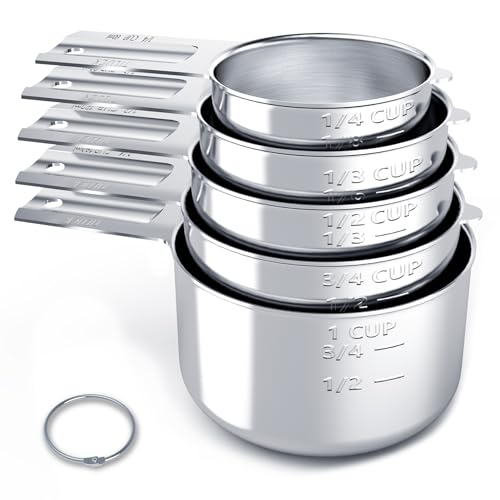
[Multiple Sizes]: Including 5 Measuring Cups (1/4, 1/3 , 1/2 ,3/4, 1 cup). Meet All Your Needs on Cooking and Baking.
Why These Four Fractions Cover the Most Common Recipe Measurements
The most common recipe measurements are 1 cup, 1/2 cup, 1/3 cup, and 1/4 cup because they combine easily. For example, adding 1/2 cup and 1/4 cup yields 3/4 cup, a frequently used measurement. Two 1/4 cups make 1/2 cup, simplifying the process of measuring small amounts. This set covers the majority of standard recipes without the need for specialized measuring tools. Historically, these fractions were adopted because they align neatly with common ingredient quantities, making cooking more straightforward. The metric equivalents—60 mL for 1/4 cup, 80 mL for 1/3 cup, and 120 mL for 1/2 cup—support the same logic, allowing you to measure nearly any volume with minimal mental math. When a recipe calls for a different shape, knowing how a bundt pan substitute performs can help you avoid ruining the bake. For heavy mixtures, a KitchenAid mixer Professional 5 Plus can handle thick batters that require precise measurement. You can also use baking soda paste to lift stubborn residue from baking sheets, which follows a similar cleaning logic to combining fractions.

[Multiple Sizes]: Including 5 Measuring cups (1/8, 1/4, 1/3 , 1/2 , 1 cup), 5 Measuring spoons (1/4, 1/2 , 1 tsp, 1/2, 1 tbsp). Meet All Your Needs On Cooking And Baking

FOUR-PIECE SET: includes 1/4, 1/3, 1/2, and 1 cup size
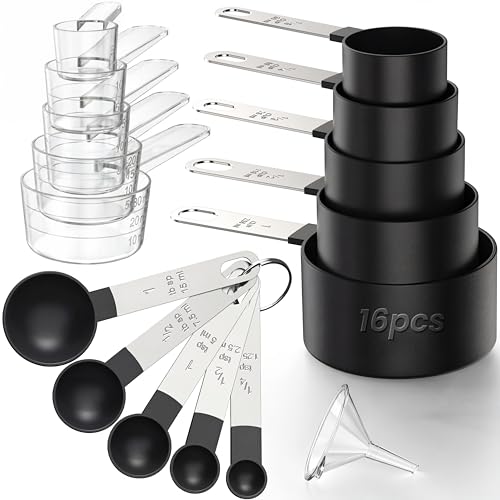
16PCS SET: Including multiple sizes, including 1cup, 1/2cup, 1/3cup, 1/4cup, 1/8cup, 30ml, 20ml, 15ml, 10ml, 5ml, 1tbsp, 1/2tbsp, 1tsp, 1/2tsp, 1/4tsp, and 1 funnel