

Choosing between the Artisan and Classic KitchenAid mixers depends on how often and what you bake.
The Classic is perfect for light baking with a 275W motor and a 4.5-quart bowl.
While the Artisan offers more power and capacity with a 325W motor and a 5-quart bowl for heavier or larger batches.
In this guide, you’ll find the details to help you pick the model that fits your baking style and needs.
KitchenAid Artisan vs. Classic: Which Should You Buy?
The KitchenAid Artisan offers a 5-quart bowl, while the Classic comes with a 4.5-quart bowl. That extra half-quart gives you more space for large batches of dough or ingredients, making your mixing process smoother and more efficient. The larger bowl is especially helpful when working with thick doughs or multiple recipes in a row. The Artisan also features a handle, which makes lifting and managing the heavier bowl easier, reducing strain and improving control during use. Durable construction is a key reason why choosing the right bakeware matters for long-term performance. For precise ingredient measurement, a food scale ensures consistent results in your baking. When using a food scale, it often pairs well with measuring spoons for small quantities of leavening agents or extracts.
Even though neither model is silent, the Artisan’s design tends to operate more smoothly and quietly, especially during longer mixing sessions. This means you can run it for extended periods without as much noise disturbance, which benefits those who bake frequently. For regular bakers, the extra capacity and handle can make a noticeable difference in convenience and workflow, fitting larger quantities comfortably without taking up additional space on your countertop.

【Perfect Fit】: JEASOM 5 Quart stainless steel mixer bowl fit for KitchenAid all 4.5QT and 5QT Tilt-Head Stand Mixers, including K45, K45SS, KN15E1X, KSM75, KSM85PS, KSM88PSQ, KSM90, KSM95, KSM96, KSM97, KSM100, KSM103, KSM105, KSM110 ,KSM120, KSM150, KSM150A, KSM151PS, KSM152, KSM153, KSM154, KSM155, KSM158, KSM160A, KSM175, KSM180, KSM180RPMB, KSM180LEBK

For Select KitchenAid Bowl-Lift Stand Mixers*
Motor Power: 325W vs. 275W and What It Means for Dough
Because the Artisan has a 325-watt motor compared to the Classic’s 275-watt unit, that 50-watt difference translates into noticeably better performance with heavy doughs. You’ll experience less strain when kneading dense pizza or whole wheat doughs, as the Artisan offers greater power efficiency for tougher tasks. The Classic handles lighter doughs well but struggles with stiff mixes, which can result in a higher noise level under load. If you bake bread frequently, the extra headroom of the Artisan helps keep your mixer running more smoothly and quietly. You don’t need that extra power for simple cookies or cakes, but for thick doughs, it provides a clear advantage. Overall, the Artisan’s stronger motor gives you confidence that your mixer won’t bog down when you push it to the limit. However, just as you might rely on household items for measuring when you lack a precise tool, your recipe’s tolerance for power matters—while a Classic can still handle bread if you knead in smaller batches, the Artisan’s wattage is the equivalent of having a proper measuring cup for dense doughs, ensuring consistent results without guesswork. For those who prioritize precision with their ingredients, using a food scale for meat weighing can ensure your portions are as accurate as your mixer’s power output. Choosing a top loaf pan will also help your bread bake evenly and hold its shape.
How Bowl Size Changes Your Baking (5-Quart vs. 4.5-Quart)
Choosing between a 5-quart and a 4.5-quart bowl depends on how much you typically bake at once. The 5-quart bowl offers more capacity, handling about 9 dozen cookies or 4 loaves of bread in a single batch. This extra space is beneficial when you’re baking for large gatherings or want to prepare multiple batches without stopping. The 4.5-quart bowl comfortably manages around 6 to 7 dozen cookies or 3 loaves, making it ideal for smaller, everyday recipes. The Classic Series 4.5-quart model includes a ceramic bowl that resists chipping and cracking, backed by a 5-year warranty.
Thick doughs tend to climb less in the larger bowl, providing more room for kneading and mixing without spilling over. For single, smaller batches, the 4.5-quart can actually be more efficient because ingredients stay closer to the beater, reducing the need to scrape down sides constantly. If you often double recipes or bake big batches for holidays, the half-quart difference helps you avoid splitting batches. Overall, choose based on your typical baking volume: larger for frequent big loads, smaller for daily ease.
What Accessories Come With Each Model?
The Artisan model comes with five accessories, while the Classic includes only four. The Artisan’s package features a 5-quart stainless steel bowl, coated flat beater, coated dough hook, 6-wire whip, and a pouring shield. In contrast, the Classic includes a bowl suited for the 4.5-quart K45 platform, along with a coated dough hook, coated flat beater, and a 6-wire whip, but it does not come with a pouring shield. Some Artisan variants also offer deluxe accessories like a flex edge beater and a 3-quart bowl, so be sure to verify the specific model code. The additional accessories in the Artisan set provide greater versatility right out of the box, making it the better choice if you want more options from the start. For comparison, other brands like Hamilton Beach often include fewer accessories in their base stand mixer packages. When evaluating which attachments truly matter, focusing on top attachment comparisons helps clarify how the included tools perform against aftermarket upgrades. For those who also value precision in baking, a kitchen scale is another essential tool often reviewed alongside mixers.

Fits all 5, 5.5 and 6 Quart KitchenAid Bowl-Lift Stand Mixers* with stainless steel bowls, * sold separately, does not fit model KN25WPBH. Please check your model number compatibility.

【Upgraded Design】The full wrap-around pouring shield and standard splatter shield chute dust cover perfectly retains the ingredients in the center for kitchenaid mixer bowl, and the mixing will be more efficient and thorough, effectively preventing splashes and spills when mixing lightweight ingredients such as flour. Upgraded dump hood with quick lock ,quickty installs ,removes reduce mess and save your time.

Pouring Chute makes ingredients go where you want them: into the stand mixer bowl, not on the counter; compatible with most KitchenAid, Cuisinart, Kenwood & SMEG stand mixers with metal mixing bowls
Is the KitchenAid Artisan’s Extra Power Worth It for Bread?
An extra 50 watts can make a noticeable difference when kneading bread. The Artisan’s 325-watt motor provides more consistent power compared to the Classic’s 275 watts. This extra power helps maintain kneading strength during longer or denser doughs, like whole wheat or enriched varieties. As a result, your dough stays well mixed and develops better elasticity without overstraining the mixer. For comparison, when using silicone baking mats in the oven, they offer a non-stick surface and even heat distribution, but their maximum safe temperature limit must be respected to avoid damage.
With the additional wattage, the Artisan handles larger batches and tougher doughs more reliably. It prevents the motor from laboring or slowing down, ensuring a smoother process. If you frequently bake bread or work with dense recipes, those extra 50 watts can translate into improved texture and less effort. Conversely, for small batches or occasional baking, the Classic’s power often suffices without noticeable issues.
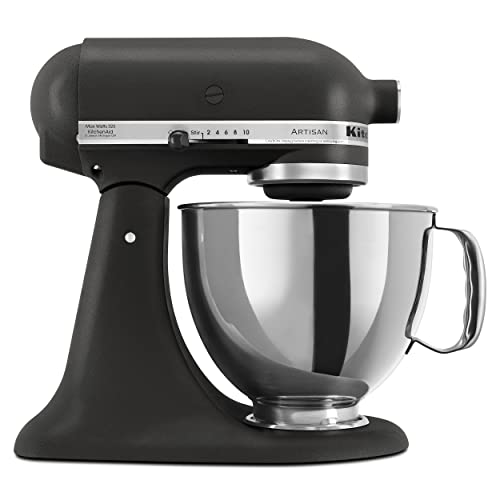
Choose from all the color options to find the one that best matches your style and personality. Important safeguard: Remove Flat Beater, Wire Whip or Dough Hook from Stand Mixer before washing. . Cord length : 36 Inches

The part for Kitchen Aid Mixer Dough Hook K45DH is a high-quality replacement for part numbers WPW10674618, AP6023721, 9708471, W10674618, 3183588, 3183589, 3451166, 4162152, 4176069, 9707671, PS11757067, and K45DH dough hook.

Over 20 Colors vs. 2 Neutrals: Does the Look Matter?
The color options for the Artisan stand out significantly compared to the Classic. The Artisan offers over 20 colors, ranging from bright hues to soft pastels, allowing you to create a personalized look that reflects your personality. This extensive palette makes it easy to match your existing décor or make a bold statement in your kitchen. Its vibrant colors can serve as a focal point or a playful accent. The Artisan model also features a stainless steel bowl that is praised for its durability and performance in many reviews. Maintaining its bright finish is easier when you follow the baked-on residue removal tips for the stainless steel bowl. For those also interested in baking accessories, purchasing a baking sheet pan with rack can enhance your cooking results.
In contrast, the Classic is limited to black and white, providing a sleek, minimalist aesthetic. These neutral shades blend seamlessly into various kitchen styles, especially those emphasizing simplicity and understated elegance. They are versatile and less likely to clash with future décor changes.
Your choice depends on whether you want a visible, color-rich appliance that adds character or a neutral piece that prioritizes harmony with your kitchen design. If you value the ability to customize and create a standout feature, the Artisan’s diverse colors are the better option. On the other hand, if you prefer a subtle look that can easily coordinate with other appliances and changing trends, the Classic’s neutrals suit you best. Despite similar performance, the visual presence often influences your overall satisfaction more.
KitchenAid Classic vs. Artisan: Is the $100+ Difference Justified?
The $100+ difference largely comes down to capacity, power, and aesthetics. The Artisan offers a 5-quart bowl compared to the Classic’s 4.5-quart size, which means you can mix larger batches in one go—ideal if you frequently bake or prepare multiple dishes at once. It also has a 325-watt motor instead of the Classic’s 275-watt model, providing extra power that handles thicker doughs and larger quantities more efficiently.
Beyond performance, the Artisan provides more customization options through a broader selection of colors, allowing you to better match your kitchen’s style. Maintenance and repairs are similar for both models, featuring the same tilt-head design and accessory set, so costs for upkeep stay comparable.
Your choice depends on how often and how much you bake. If you regularly prepare large batches or value matching your appliance to your kitchen decor, the extra investment in the Artisan is justified. For lighter, infrequent baking, the Classic covers the essential functions at a lower price, making it a practical choice.

10-speed slide control ranges from a very fast whip to a very slow stir. Cord length : 36 Inches
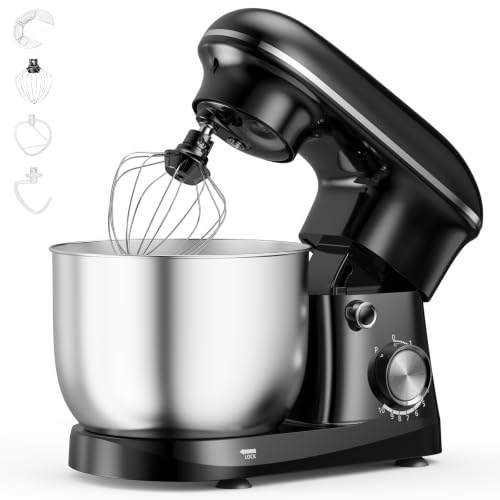
Motor and Speed Options: OLIXIS packs a 300W motor with ten speed levels to mix anything from stiff pizza dough to runny cake batter Rivals well-known kitchen stand mixers for all your home baking projects

【Digital Switch Control and Display】Brand new upgrade. This kitchen mixer has an electronic screen display, 8-speed and 15-minute adjustment, access to multipurpose and a variety of recipes. After clicking power on, press speed/time, increase or decrease the time and speed by twisting the knob, and then click power-on again to start the machine.(For specific operations, please refer to the Operation Guide section of the manual)
Same Tilt-Head, Same 10 Speeds: So What’s Different?
Although both the KitchenAid Artisan and Classic feature the same tilt-head design and 10-speed settings, they are not interchangeable due to their power and capacity differences. The Artisan’s 325-watt motor is more reliable when handling heavier loads like thick doughs, compared to the Classic’s 275-watt motor. The Artisan’s 5-quart polished bowl with a handle makes lifting and pouring easier, whereas the Classic’s brushed stainless steel bowl lacks a handle, making it slightly more cumbersome to use. To keep the Artisan’s bowl and attachments in pristine condition, using a gentle cleaning method helps prevent scratches and baked-on residue.
Both models support attachment versatility through the hub, allowing you to add pasta rollers, ice cream makers, or other accessories. However, the Artisan’s extra power and larger batch capacity—up to 9 dozen cookies versus 8—make it better suited for serious bakers or those who regularly work with larger quantities. For bakers focused on decorative finishes, the Artisan’s greater torque also ensures consistent results when using a piping tips chart for frosting intricate designs. Color options also vary, with the Artisan available in dozens of shades, while the Classic mainly offers neutral tones. A tube pan is a better choice for bundt-style cakes than a standard round pan when using the Artisan’s higher torque for dense batters.
Which Mixer Fits Occasional vs. Frequent Bakers?
The Artisan is better suited for frequent bakers. Its 325-watt motor and 5-quart bowl provide ample capacity and power to handle denser doughs, larger cookie batches, and recipe scaling without splitting mixes or risking overflow. This mixer makes it easier to manage higher output and more demanding baking routines, such as regular bread baking or doubling recipes, reducing your workload. For those seeking the best balance of performance and value, top picks often highlight the Artisan as a superior long-term investment. In contrast, the Classic is designed for occasional use and tighter budgets, offering enough features for less frequent bakings but less suitable for heavy, routine tasks. For bakers who also tackle cheesecakes or delicate tortes, springform pan substitutes can be a lifesaver when your usual pan is unavailable. Mastering the step-by-step instructions for crochet pot holders requires precise tension and stitch consistency.

Built to take it all on with the durable and built-to-last metal construction, and 59 touchpoints around the mixer bowl for great mixing results.
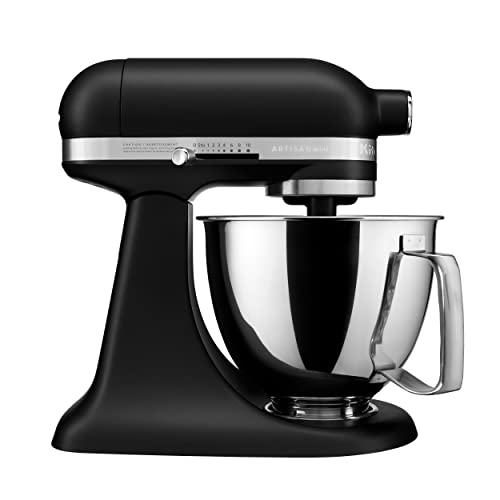
Lighter. Smaller. Just as Powerful. With the same power as the KitchenAid Classic Stand Mixer, the Artisan Mini weighs less so it's easier to move around and is smaller, taking up less counter space.

Durable and built-to-last metal construction, with 59 touchpoints around the mixer bowl for great mixing results.
KitchenAid Artisan vs. Classic: The Bottom Line for Your Kitchen
The Artisan offers a more powerful motor and larger bowl than the Classic, making it better suited for tougher mixing tasks and larger batches. The Artisan’s 325-watt motor provides extra strength, allowing it to handle thicker doughs without straining or overheating. Its 5-quart bowl with a handle simplifies batch prep and makes it easier to transfer ingredients. Additionally, the Artisan comes in a wider range of colors, so you can more closely match your kitchen’s aesthetic. For even pressure when rolling out dough by hand, a top rolling pin can be a critical tool for bakery success.
The Classic, with its 275-watt motor and 4.5-quart bowl, covers basic mixing needs at a more affordable price. Both mixers share the same footprint, so counter space isn’t a concern. If you prioritize power and customization, the Artisan is the better choice. If you want reliable performance without extra bells and whistles, the Classic delivers good value for everyday tasks.