

Ever wonder what exactly a baking sheet is? It’s a simple, flat metal pan with raised edges, most often measuring 18 by 13 inches—the standard size for many baking tasks.
Choosing the right material, like aluminum or aluminized steel, can make a difference in how evenly your food cooks.
Keep reading to discover which type suits your kitchen best.
What Exactly Is a Baking Sheet (and What Isn’t It)?
A baking sheet is a flat, rectangular metal pan with raised rims on all four sides, typically measuring around 13 by 18 inches. It is designed for oven use and used for baking cookies, roasting vegetables, or preparing sheet-pan meals. Unlike a deep cake pan or a flat cookie sheet, it has rims on all sides to contain food and prevent spills. The color of the baking sheet influences heat absorption: darker sheets tend to brown food faster because they absorb heat more efficiently, while lighter sheets reflect heat and result in more even cooking. Check the oven temperature limit on your baking sheet—most can handle up to 450°F—since cheaper options may warp or become damaged at higher temperatures. Using a Silpat mat on your baking sheet can reduce cleanup and requires specific care to prevent baked-on residue from building up. Choosing the right baking sheet for your specific task ensures better cooking results and longer-lasting equipment.
Why Your Baking Sheet’s Material Actually Matters
The material your baking sheet is made from greatly influences how well it performs. Aluminum is the top choice for quick heat transfer, providing even browning and reducing hot spots. Aluminized steel offers a combination of good heat conduction and added strength, resisting warping better than thinner pans. Stainless steel, on the other hand, is a poorer heat conductor, which can result in uneven baking. Dark-colored pans absorb more heat, speeding up browning—ideal for cookies but risky for delicate baked goods. Light-colored sheets reflect heat, delivering gentler, more uniform results. Thicker, heavier-gauge pans help prevent warping and maintain a flat surface during baking. Choosing aluminum prioritizes responsiveness, aluminized steel balances durability and performance, and tri-ply constructions combine both benefits for versatile results. Your material selection directly affects every bake outcome. For tough jobs, choosing a model built like a commercial mixer can also help prevent warping and maintain even heat distribution over time. Remember that wax paper is not a substitute for parchment paper and should never be used directly on a baking sheet in the oven.

PURE UNCOATED ALUMINUM & SUPERIOR HEAT CONDUCTION: Crafted from 100% bare aluminum with NO chemical coatings – guarantees safe, toxin-free cooking. Engineered for lightning-fast, even heat distribution (up to 30% faster than steel!) for perfectly crispy cookies, golden roasted veggies, and juicy meats every time. The aluminum baking pans are made of thick and heavy aluminum, with a heavy rolled edge making this truly "commercial-grade"that provides maximized scratch resistance

1/2 Size – Large flat baking surface ideal for baking cookies, roasting vegetables or baking desserts
Baking Sheets vs. Roasting Pans vs. Jelly Roll Pans
A jelly roll pan sits between a baking sheet and a roasting pan in terms of size and design. It typically measures around 15 by 10 inches with low sides, making it ideal for specific baking tasks. Its shallow height allows for light containment of delicate baked goods like sponge cakes or bar cookies, which benefit from even heat distribution and easy removal. For reviewing the best options, non-stick baking sheets provide excellent release and easy cleanup for perfect results. However, if you plan to use the pan in an air fryer, check that it is safe to use without blocking airflow or causing damage. Using a hand mixer with the correct wire whip attachments can ensure perfectly aerated batters for these delicate cakes.
You can swap a jelly roll pan for a baking sheet if your recipe calls for a slight edge or more containment, but you’ll lose some airflow. This can result in less crispiness or uneven browning. When choosing a pan, consider the material: aluminum pans heat quickly and promote even browning, perfect for cookies and pastries, while stainless steel pans are more durable and suited for dishes involving liquids or roasting. Always match the pan’s depth to your dish’s liquid output to prevent splattering or overflow.

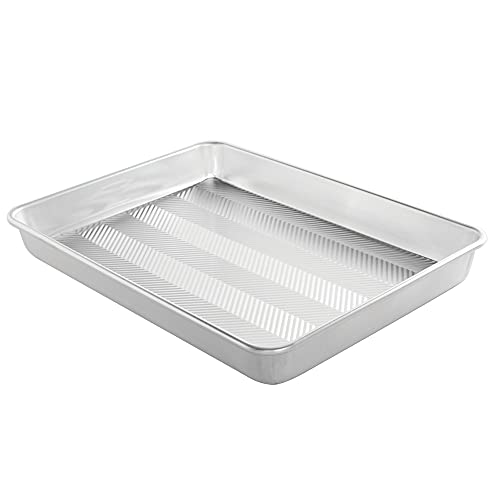
INGENUITY DIAMOND TEXTURE - This rimmed baking sheet has a diamond texture on the base increases its non-stick properties and ensures even and quick heat airflow to the cookie, which makes the cookies consistently baked without any over or undercooked part

INGENUITY DIAMOND TEXTURE - This rimmed baking sheet has a diamond texture on the base increases its non-stick properties and ensures even and quick heat airflow to the cookie, which makes the cookies consistently baked without any over or undercooked part

Naturals commercial bakeware is made of pure aluminum which will never rust for a lifetime of durability.
Standard Sheet Sizes You Should Know
Full sheet pans measure 26 by 18 inches, making them too large for most home ovens. Instead, the half sheet size—18 by 13 inches—is the most versatile for everyday use. It fits standard home ovens comfortably and is ideal for baking cookies, roasting vegetables, and sheet pan dinners. For smaller batches or appliance-specific tasks, quarter sheet pans (13 by 9 inches) work well. Eighth sheet pans, approximately 9.5 by 6.5 inches, are suitable for toaster ovens or when you need to prepare small portions. Using spray oven liners can simplify cleanup, especially when testing seasonal recipes like pumpkin desserts. Overall, sticking with a half sheet pan offers the best balance of size and utility for most home cooks. Just as dry measuring cups are best for precise flour and sugar quantities, choosing the right pan size ensures consistent baking results.
INGENUITY DIAMOND TEXTURE - This half sheet pan has a diamond texture on the base increases its non-stick properties and ensures even and quick heat airflow to the cookie, which makes the cookies consistently baked without any over or undercooked parts.
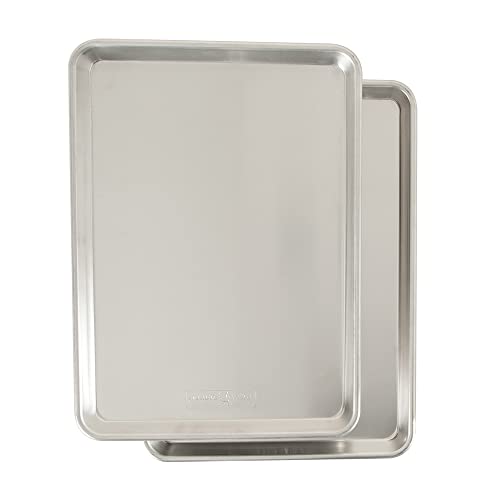
Naturals bakeware is made of pure aluminum for superior heat conductivity and produces consistently evenly browned baked goods every time.

Naturals bakeware is made of pure aluminum for superior heat conductivity and produces consistently evenly browned baked goods every time.
6 Key Features of a High-Quality Baking Sheet
The material of your baking sheet is crucial for durability and even baking. Heavy-gauge aluminized steel is an excellent choice because it resists warping and distributes heat uniformly, reducing hot spots that can scorch your baked goods. A warp-resistant rolled edge not only adds strength but also makes handling safer and easier. For the surface, look for a ceramic coating that is PTFE- and PFOA-free. Such coatings release food easily, resist scratches, and simplify cleanup. Make sure the pan feels sturdy and dent-free—any flimsiness could lead to warping and uneven results over time. For long-term reliability, choose a sheet that matches the durable construction found in high-end stand mixer bowls. To keep your baking sheets in top shape, measure your oven’s interior to ensure a snug fit and store sheets vertically to avoid scratches and deformation. For added versatility, consider how KitchenAid mixer attachments can expand your baking capabilities. Prioritizing these features ensures you pick a baking sheet that remains reliable batch after batch. Similarly, achieving consistent results with a Bundt pan requires understanding its proper bake time, which varies based on pan material and batter volume.

Classic half sheet pan set of 2 for baking, roasting, bacon, cookies, vegetables, and cakes; commercial grade and heavy gauge aluminized steel

Classic Extra Large Nonstick Baking Sheet Pan for baking and roasting cookies vegetables and cakes - commercial grade and heavy gauge aluminized steel

Nonstick Quarter Sheet Pan for baking cookies, roasting vegetables, reheating leftovers; commercial grade and heavy gauge aluminized steel
The Best Sheet for Cookies, Pastries, and Sheet Cakes
A half-sheet pan is the best choice for cookies, pastries, and sheet cakes because of its versatile size and practicality. Its standard dimensions—typically about 18 by 13 inches—provide enough room for even baking while fitting comfortably in most standard ovens. For cookies, the ample space allows you to spread portions apart, promoting even browning and preventing overcrowding that can cause uneven baking. Pastries benefit from the rimmed edge, which helps contain butter, fillings, and crumbs, making cleanup easier and reducing spill risk. A bacon rack for oven can also be placed on a half-sheet pan to elevate meat and allow grease to drip away during cooking. A KitchenAid mixer with bowl can efficiently prepare doughs and batters for these pans, ensuring consistent results. For those using a Hamilton Beach stand mixer, compatible top attachments greatly expand the pan’s utility for mixing doughs and batters.
When baking sheet cakes, especially traditional layered or single-layer cakes, the 9 x 13 inch pan is ideal. It offers the necessary depth for rising and makes slicing straightforward without excess crumbling. Quarter-sheet pans, measuring roughly 9 by 13 inches but with lower sides, suit small batches and are easy to store due to their compact size. They also work well for single-layer cakes or when working in limited oven space.
For decorating, the rimmed half-sheet pan can catch drips, keeping your workspace cleaner. Overall, sticking with a half-sheet pan covers most baking tasks efficiently, while having a quarter-sheet or 9 x 13 inch pan on hand can handle specific needs without complicating your baking setup.
Better Airflow for Crisping

Baked goods rise and bake evenly due to aluminums superior heat conductivity and the reinforced encapsulated steel rim prevents warping

HEALTHY & NONTOXIC STAINLESS STEEL: Our baking sheet made of food-grade pure 18/0 stainless steel without chemical coating or any other materials, Good heat and corrosion resistance, Safe enough to baking all kinds of dishes and without leaching anything harmful, Healthier alternative to aluminum pans for everyday baking use. Compared with glass or ceramic sheet pan, it is unbreakable. Compared with aluminum, it is more healthy. ALSO, more environmentally friendly than disposable baking pans.
How to Clean a Baking Sheet (Without Ruining It)
To clean your baking sheet without damaging it, start with the right approach based on its material. For nonstick sheets, avoid harsh scrubbing or abrasive cleaners that could scratch the coating. Instead, use warm water and mild dish soap for routine washes. For stubborn residue, create a baking soda paste by mixing baking soda with a small amount of water. Spread it on the surface, let it sit for 15 minutes, then scrub gently with a non-abrasive sponge or soft cloth.
Tougher stains benefit from a mixture of baking soda and hydrogen peroxide. Apply the paste, leave it on for a few hours, then rinse thoroughly. You can also deodorize and refresh your baking sheet by soaking it in hot water combined with baking soda and a splash of vinegar. Always dry your baking sheet completely after cleaning to prevent spots and corrosion. Avoid using steel wool or metal scrapers, as they will scratch and damage the surface, compromising its nonstick qualities or finish. Using gentle cleaning methods ensures your baking sheet stays in good shape and performs like new.
Baking Sheet Mistakes to Avoid
Avoid overcrowding your baking sheet by leaving small gaps between items. This allows air to circulate properly, preventing steaming and promoting even browning. Use the right type of sheet: thin pans can warp under high heat, while dark-colored sheets tend to brown food faster than lighter ones. Warped sheets cause uneven baking and often shorten the lifespan of the pan. Never use metal utensils on nonstick surfaces, as scratches destroy their release performance. Instead, opt for wooden or silicone tools to prevent damage. Make sure liners and spacing are well managed; bunching causes uneven results. During baking, rotate your pans midway to handle hot spots. Proper handling also includes seasoning your sheets, which helps maintain their nonstick qualities and extends their usability. For stubborn baked-on residue, baking soda paste offers an effective cleaning method without damaging the surface. Applying a gentle scrubbing sponge after soaking helps lift the residue without scratching the pan. Consider investing in a durable mixer cover to protect your equipment from dust and scratches when not in use.