

Ever wonder how to get the most accurate measurements from your food scale? Knowing how to properly use and read your scale can make a big difference in cooking and baking success.
By mastering a few simple steps, you’ll ensure your ingredients are measured precisely every time. Keep reading to learn the basics that will set you up for accurate and consistent results.
Why Use a Food Scale in the First Place?
Using a food scale ensures you measure ingredients by weight instead of volume, reducing measurement errors. Cups can vary based on how ingredients are packed, their density, or their shape, but weight remains consistent. Relying on “eyeballing” or visual estimation often leads to portion inaccuracies, whereas weighing helps you match servings precisely to your planned portions. This makes controlling your intake of calories, carbs, and macros more accurate and reliable.
A food scale also makes your recipes more consistent, batch after batch, because measurements stay precise every time. It helps prevent over-adding ingredients, which reduces food waste. Plus, with exact measurements, you can see what common portion sizes look like, making it easier to learn serving sizes and develop good habits. For cooking and baking, a scale offers superior precision and consistency compared to traditional measuring cups, leading to better results every time. For bakers using a stand mixer, a food scale ensures you measure the exact weight of flour and other dry ingredients, which is far more reliable than using a measuring cup, especially when paired with top attachments for KitchenAid mixers that require precise ratios for optimal performance. Choosing a high-quality model ensures you get accurate readings for every ingredient, making your weight-based measurements truly dependable.

Contemporary Slim Design: Made of Stainless Steel Material; It is easy to use and clean; Provides accurate weight data with a user-friendly control panel and system; With high precision sensors to ensure correct performance and readouts

【PRECISE WEIGHT】 The digital food scale built-in four high-precision load sensors, quickly and accurately response 1g or 0.1oz increments when adding ingredients, its measuring range: 0.1oz to 22 lbs and 3g to 10kg(Min. weigh at 0.1oz or 3g).
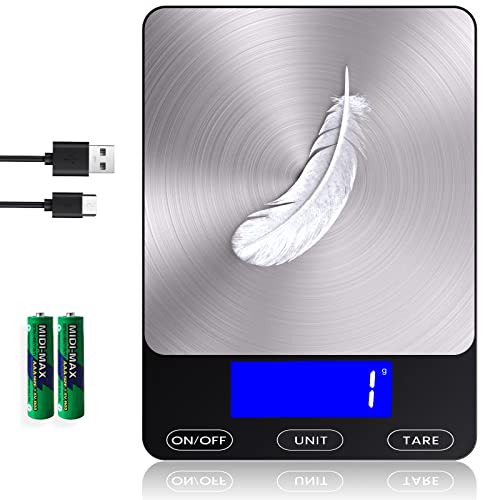
【Precise Weight Food Scale】Our Food Kitchen Scale equips four high-precision load sensors, waterproof Anti-collision glass weighing panel. Large measuring capacity with 1g precise graduation from 0.1oz/3g to 33 lbs/15kg.
How to Set Up Your Scale for Accurate Readings
To set up your scale for accurate readings, start by placing it on a hard, flat, and level surface. Avoid soft surfaces like towels or rugs, as they cause wobbling and inaccurate measurements. Keep the scale away from air drafts, vibrations, and nearby appliances to prevent fluctuations. Insert fresh batteries following the polarity markings, and power on the scale. Allow it to stabilize and reset to zero before you begin weighing. For calibration, use a known test weight, such as 200 grams or 500 grams, placed in the center of the platform; consult your scale’s manual for the specific weight requirements. If you plan to store the scale for an extended period, remove the batteries and keep it in a dry, stable place to maintain its accuracy.

Digital kitchen scale with food-safe, BPA-free plastic components

500 g Capacity with 0.01 g Readability: This gram scale measures powders, jewelry, coins, tea, and other small items accurately, helping you get consistent results for everyday weighing

CALIBRATION WEIGHTS SET: This 5-piece calibration weights set includes 1g, 2g, 5g, 10g, and 20g cylindrical gram weights, labeled M1 grade by the manufacturer, for routine checks of digital scales at home or for shipping.
Using the Tare Function the Right Way
The tare function is the smartest way to measure ingredients accurately on your digital scale. To use it, place an empty container such as a bowl or cup on the scale first. Then, press the tare button to reset the display to zero with the container still in place. This way, only the weight of your ingredients will show when you add them. If you need to add multiple ingredients to the same container, press tare again between each addition to zero out the weight each time. For consistent results, it is wise to periodically calibrate a gram scale using a known weight to ensure the tare function remains accurate.
It’s important to stay within the scale’s maximum capacity. A container that is too heavy can reduce the scale’s ability to measure accurately or cause it not to register at all. Also, avoid pressing tare with food already in the container, as this will give you false readings. If you accidentally tare while the container contains food, you might see a negative number. Simply remove the item, press tare to reset to zero, and continue. For sticky or baked-on residue, similar care is needed to avoid false readings from leftover debris affecting the scale’s sensor. Regularly cleaning the sensor area with a soft cloth helps prevent baked-on residue from interfering with accuracy.

𝗘𝗳𝗳𝗼𝗿𝘁𝗹𝗲𝘀𝘀 𝗪𝗲𝗶𝗴𝗵𝗶𝗻𝗴: Supports 5 units (oz/lb:oz/fl'oz/g/mL), tare function, and includes 2 AAA batteries for hassle-free operation

30 lb Heavy-Duty Capacity: Measure large roasting pans, heavy Dutch ovens, and full mixing bowls without dividing portions or guessing weights.

【Precise Weight】 10kg/22lb capacity, 1g/0.1oz resolution, Great for cooking, baking, weight loss, Meal Prep, Coffee, Package, Postage.
How to Weigh Different Ingredients Without the Guesswork
Weighing ingredients accurately without guesswork begins with a few simple steps. First, place your scale on a flat, stable surface to ensure consistent measurements. Choose a container, such as a bowl or jug, that can comfortably hold your ingredients without spilling. Switch your scale to the measurement unit called for by your recipe—usually grams for the best precision.
For dry ingredients, spoon or pour them into the container until you reach the desired weight. This method prevents issues caused by packing or scooping variations, resulting in more consistent measurements. For liquids, add them slowly to the container, pausing frequently to check weight and avoid overshooting. Weighing by mass ensures every ingredient is measured precisely, regardless of how compact or fluffy it might be.
When weighing multiple ingredients in one bowl, add the first item, reset the scale to zero, then add the next. This process saves time and reduces dishwashing. For doughs, meatballs, or other items that can be directly placed on the scale, use a cover or platform to prevent sticking and maintain cleanliness. Overall, weighing ingredients by their mass provides reliable, repeatable results and minimizes guesswork in your cooking or baking.

[MULTI-FUNCTION SWITCHING MODE]--Food scale can bear a maximum weight of 11LB, and can also provide you with a weight scale accurate to 1 g/0.05 oz. The measurement results are highly accurate. Food scale grams and ounces also has six unit conversion functions: g/kg/lb/oz/ml/milk ml to meet your different needs. When you are making food, there is no need for complicated operations, just one button to easily switch to any unit you want, providing all-round convenience for kitchen work.

【Two Power Source】:USB charging or 2 AAA batteries power supply, you can use it more reliably.

𝗠𝗮𝘅 𝗖𝗮𝗽𝗮𝗰𝗶𝘁𝘆: Weigh objects as heavy as 22 lb/10 kg and as light as 2 g in increments of 1 g
Common Mistakes That Ruin Your Measurements
Avoid mixing grams and ounces during the same session. Stick to one unit to prevent conversion errors that can throw off your measurements. Additionally, don’t read the scale’s display before it stabilizes; waiting a few seconds ensures accurate readings. Keep your scale clean and free of dust or debris, which can cause inconsistent results. Regularly check your scale against a known weight to catch any hidden bias that might skew your measurements. This simple step helps maintain precision and prevents small errors from accumulating over time. For example, a slowly drifting reading could indicate the scale needs a quick zero reset to stop the value from climbing. For parallel accuracy, thoroughly prep the cake pan using a fat-based liner to prevent sticking and ensure even release. Consider using a KitchenAid stand mixer for consistent mixing that complements your weight-based measurements.
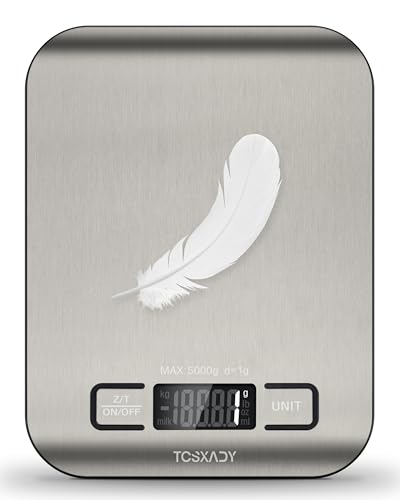
【Versatile Measurement Mastery】Tcsxady food scale supports 6 units (g/kg/lb/oz/ml/milk ml) for baking, meal prep, or liquid tracking. Optimized for recipes requiring precise conversions, it replaces guesswork with quick-tap unit switching. Ideal for food scales for kitchen enthusiasts prioritizing flexibility.

UNIQUE FEATURE: IPX7 Waterproof rating for easy clean up. Scale's digital components are water tight and can be rinsed under water. See instruction manual for additional cleaning information.
