

Wondering how to perfectly bake delicate desserts like cheesecakes or tarts? A springform pan might be exactly what you need. It features a removable side ring that makes lifting out your creation easier and mess-free.
Sizes range from 6 to 10 inches, with 9 inches being the most adaptable for many recipes.
Keep reading to learn the best uses for each size and how to choose the right one for your baking needs.
What Is a Springform Pan and How Does It Work?
A springform pan is a two-piece baking pan with a flat base and a removable side ring. The side ring is secured by an exterior latch that locks in place during baking. Before pouring in your batter, you fit the base and the ring together, creating a secure mold. The latch keeps the sides tight and prevents leaks as your dessert bakes. Once the cake cools, you simply release the latch and lift the ring straight off, leaving your delicate creation intact. This design eliminates the need to flip or invert the pan, reducing the risk of crumbling or breaking fragile desserts. It’s especially useful for cheesecakes, tarts, and other delicate treats that require gentle handling. Unlike a bundt pan, a springform pan does not require a tube or fluted center to define the cake’s shape. Many bakers also use stand mixer attachments to efficiently prepare the batter for these delicate desserts. For recipes requiring precise ingredient portions, a food scale ensures accurate measurements for consistent results. The springform pan ensures your cake maintains its shape and presentation, making it a must-have tool for precise, clean results.

Double-Coated Quantum2 Nonstick — Helps cheesecakes, tortes and other delicate bakes release cleanly while simplifying cleanup after service Heavy-Duty Aluminized Steel —...
Why Bakers Rely on Springform Pans for Cheesecakes
Springform pans are essential because cheesecakes are too fragile to flip like traditional cakes. The removable sides allow you to release the cake easily without damaging its delicate custard filling or crumb crust. This design helps you keep the top smooth and intact, making decorating and slicing much simpler. To maintain your springform pan, wash the base and ring separately by hand and avoid submerging the latch mechanism to prevent rust. For cleaning baked-on residue, use hot water and gentle scrubbing to lift stubborn bits without damaging the pan’s nonstick surface. For the best results, line the base with top parchment paper to prevent sticking and ensure effortless removal. Achieving accurate liquid measurements for the filling is easier when using quality measuring cups designed for precise cooking and baking.
When baking a water bath, wrap the base in foil to prevent leaks, and you can serve the cheesecake directly from the pan to reduce handling. Overall, the springform pan’s ease of use and gentle release process make it the top choice for both home bakers and professionals.
What Size Springform Pan Should You Choose?
Springform pans range from 6 to 10 inches in diameter. Choosing the right size depends on how many servings you want and the recipe’s yield. For two to four people, a 6-inch pan is ideal for mini cheesecakes or tall layered desserts. An 8-inch pan works well for family-sized treats without taking up too much fridge space. The 9-inch pan is very versatile, suitable for most cheesecakes and quiches, especially if the recipe doesn’t specify a size. For larger gatherings, a 10-inch pan provides bigger portions and more servings. Unlike a jelly roll cake pan, which is designed for thin, rolled cakes, a springform pan’s ability to unclip for easy release makes it best for delicate desserts. For accuracy in any baking project, it helps to use top measuring cups to ensure precise ingredient amounts. When selecting a pan, the best rolling pin can also help achieve even dough thickness for consistent results.
Always match the pan size to the recipe’s capacity to avoid overflow or underfilled desserts. Keep in mind that different pan materials, such as nonstick versus metal, influence heat distribution and how easy it is to clean. Smaller pans tend to produce taller, more compact desserts, while larger pans make wider, shorter cakes. First, consider how many people you plan to serve, then check the recipe’s volume to select the proper size and prevent baking mishaps.

This 9 inch springform pan accommodates standard size recipes

BUILT TO LAST: This springform pan’s heavy-duty construction resists warping and heats evenly to brown beautifully and help reduce hot spots
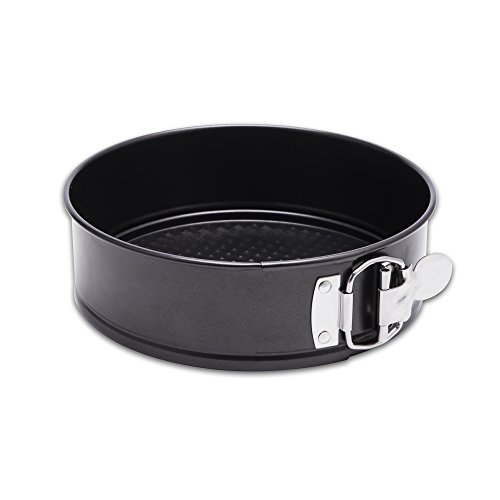
HEALTHY COATING: Our Non-stick coating is a food grade safety coating with no harsh chemicals or hazardous substances. The true double layer coating allows the cake be easily removed without damage. Avoid making it difficult to clean the cake because it sticks to the pan or leaves a lot of cake residue.
How to Measure a Springform Pan Correctly
Start by measuring the opening—specifically, the interior diameter—not the rim. Place a ruler straight across the top inner edge from inner edge to inner edge, keeping it level. This interior width represents your usable baking space and is crucial for matching recipes. Since pan material affects heat transfer, knowing the precise internal dimensions helps you adjust cooking temperatures accurately. Similarly, caring for Silpat mats requires precise attention to cleaning methods to lift baked-on residue and keep them looking new.
Next, measure the depth from the inside bottom up to the top of the sidewall lip. Keep the ruler vertical and avoid slanting it. Most depths fall between 2 and 3 inches, but measuring ensures you’re aware of your specific pan. To estimate capacity, fill the pan with water and count cupfuls. This provides a reliable volume measure, especially useful when adjusting recipes for different pan sizes.
Always refer to the manufacturer’s specifications. For example, a 9-inch springform pan typically holds about 10 cups, while a 10-inch pan can contain roughly 12 cups. Confirm that your interior measurement matches these listings, since exterior dimensions can be over an inch larger. Focus on the interior diameter for accurate and consistent baking results.

TOXIN-FREE & DURABLE 304 STAINLESS STEEL - Crafted with food-grade 304 stainless steel, the springform pan resists rust, deformation, and corrosion for lifelong use. Oven safe up to 500°F, pressure cooker compatible, and multiple baking options for you to choose from

9-inch springform pan made of heavy-gauge aluminized steel for fast, even heating

Multi-Purpose: The well-designed 9-inch springform pans are ideal choices for making cheesecake, quiche, mousse, deep dish pizza, smash cakes, various pies, cookies, and is also the best tool for DIY desserts, allowing you to enjoy your baking time
When to Use 6-Inch, 8-Inch, 9-Inch, or 10-Inch Pans
A 6-inch pan is ideal for mini cheesecakes and test recipes, serving about two people. Its small size is perfect when you want a single small portion or are experimenting with a new recipe. An 8-inch pan works well for medium-sized desserts and smaller households, providing a taller cake without excess batter. It balances portion size with ease of handling. The 9-inch pan is the most versatile option, fitting standard recipes comfortably and suitable for families. It generally produces a classic cheesecake or similar baked good with even layers. A 10-inch pan is best for larger crowds or party-sized desserts, allowing for more slices. Just keep in mind that larger pans spread the batter thinner, which can affect baking time and texture. Adjust bake times based on your pan size and material, and always match your recipe to the pan’s capacity to avoid shallow or overly dense layers. Always check material limits for any glass or ceramic components before placing them in the microwave.