Wondering which baking sheet is best for even, perfectly baked cookies? The choice often comes down to aluminum versus stainless steel, with aluminum typically leading in heat transfer and affordability.
But stainless steel has its own strengths, like durability and a non-reactive surface.
Keep reading to see how these differences might influence your baking results and long-term satisfaction.
Why Aluminum Browns Cookies More Evenly Than Stainless Steel
Aluminum browns cookies more evenly than stainless steel because its thermal conductivity is roughly four times higher. This allows aluminum to transfer heat rapidly and uniformly across the entire baking sheet, resulting in consistent browning from edge to center. You’ll notice fewer hot spots, which means your cookies will brown evenly without patchy patches. Aluminum’s efficient heat flow helps the bottoms of cookies set and brown uniformly, reducing the chances of burnt edges or underdone centers. However, aluminum’s chemical reactivity can be a concern when baking with acidic ingredients, as it may alter flavors. To prevent this, choose pans with a non-reactive surface finish, such as anodized aluminum, which seals the metal and preserves its heat-conducting benefits while avoiding unwanted reactions. For home bakers looking to expand their capabilities, the versatile attachments for Kitchenaid mixers can streamline mixing tasks for consistent doughs. Overall, aluminum’s superior ability to distribute heat evenly makes it the ideal choice for achieving reliably uniform browning in baked goods. For precision baking, a kitchen scale ensures consistent dough weights, as emphasized in comparisons of baking tools. Choosing a Hamilton Beach mixer can further simplify your baking workflow by providing reliable stand mixer performance for large batches.
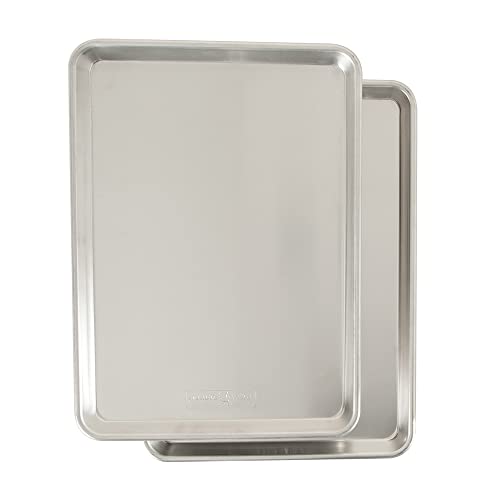
Naturals bakeware is made of pure aluminum for superior heat conductivity and produces consistently evenly browned baked goods every time.

Bake with confidence with Wilton Aluminum Pans. Designed in the USA and made from natural anodized aluminum, this 9x13 Inch rectangular sheet cake pan delivers durability and rust-resistance, ensuring a consistent result every time.

Ideal for any recipe - Designed for jelly rolls, Swiss rolls, pastries and roasting vegetables. Features a true Jelly Roll design with straight sides for ideal corners.
How Stainless Steel’s Slow Heat Affects Your Baking Results
Stainless steel’s slow heat transfer results in uneven heat distribution across your baking sheet. This can cause hot spots near the oven rack while edges lag behind, leading to inconsistent doneness within one batch. To improve results, extend your preheat time, place the sheet on a higher oven rack, and rotate the pan during baking. Expect lighter and softer baked goods unless you intentionally adjust baking times to compensate for the slower heat conduction. Using a food scale for accurate macro counting can help you precisely measure ingredients to offset the variability in baking results from uneven heat. For more consistent baking, consider choosing a cake pan with lid that is designed for even heat retention and durability. When choosing a pan, standard Texas sheet cake dimensions often require careful heat management to avoid underbaking the center.
Which Material Handles Acidic Foods Better for Roasting?
Stainless steel handles acidic foods better for roasting because its non-reactive surface prevents leaching metallic flavors, discoloring ingredients, or developing pitting. Unlike bare aluminum, which reacts with acids like tomatoes, citrus, or wine, stainless steel maintains the integrity of the ingredients’ flavor and appearance. This chemical stability ensures your roasted dishes taste bright and true, especially during longer roasting times. If you prefer aluminum, choose anodized or coated versions to minimize direct contact with acids. Overall, for worry-free roasting of acidic foods, stainless steel is the safest and most reliable option. To keep your stainless steel sheet in top condition, a thorough cleaning method like using a gentle baking soda paste helps lift stubborn residue without scratching the surface. When cleaning glass bakeware, it is critical to avoid thermal shock by not placing hot dishes directly into cold water.
Aluminum vs Stainless Steel Baking Sheet: Durability and Warping
Stainless steel is more durable and resists warping better than aluminum. Stainless steel’s strength and rigidity prevent dents and deformation under normal use, making it suitable for frequent, heavy-duty use. Aluminum, being softer, is more prone to bending and warping, especially if exposed to sudden temperature changes. For those seeking a baking sheet pan with rack for heavy-duty tasks, stainless steel’s rigidity ensures a flat surface under load.
Heat causes aluminum to expand more than stainless steel, increasing the risk of buckling if it’s cooled quickly with cold water. This can result in a permanently warped sheet, leading to uneven baking and visible color contrasts on baked goods. Stainless steel tolerates thermal stress more effectively, but neither material is completely warp-proof. For those seeking a stainless steel bowl for mixing, durability and performance are similarly prioritized. Using a precision food scale can further ensure consistent ingredient weights for balanced baking results.
You can reduce warping risks by gradually heating and cooling your baking sheets. Thicker aluminum sheets tend to hold up better over time compared to thinner stainless steel sheets, but for demanding use, stainless steel’s rigidity generally maintains a flat surface longer.

HEALTHY & NONTOXIC STAINLESS STEEL: Our baking sheet made of food-grade pure 18/0 stainless steel without chemical coating or any other materials, Good heat and corrosion resistance, Safe enough to baking all kinds of dishes and without leaching anything harmful, Healthier alternative to aluminum pans for everyday baking use. Compared with glass or ceramic sheet pan, it is unbreakable. Compared with aluminum, it is more healthy. ALSO, more environmentally friendly than disposable baking pans.

HEALTHY & NONTOXIC STAINLESS STEEL: Our baking pan set made of food-grade pure 18/0 stainless steel without without chemical coating or any other materials, Good heat and corrosion resistance, Safe enough to baking all kinds of dishes and without leaching anything harmful, Healthier alternative to aluminum pans for everyday baking use. Compared with glass or ceramic sheet pan, it is unbreakable. Compared with aluminum, it is more healthy. ALSO, more environmentally friendly than disposable baking pans.

Naturals bakeware is made of pure aluminum for superior heat conductivity and produces consistently evenly browned baked goods every time.
How Core Thickness and Gauge Prevent Hot Spots and Warping
Using a thicker gauge metal, such as 13-gauge or 18-gauge, is key to preventing hot spots and warping in baking sheets. Lower gauge numbers indicate a thicker sheet, which provides greater thermal mass. This means the metal can absorb and distribute heat more evenly, slowing rapid temperature changes that cause hot spots. The added mass also reduces the likelihood of warping by dampening thermal expansion differences across the surface. Thin pans, on the other hand, tend to flex more easily, leading to uneven expansion that can bend the metal over time. Choosing a heavy-gauge sheet ensures more uniform heating and greater durability, making it less prone to both surface warping and corrosion. Similar to how a bundt pan relies on its fluted design for even browning and structural support, a thick baking sheet uses its mass to prevent distortion. For efficient baking, a robust metal sheet works similarly to a powerful mixer attachment in evenly distributing energy across a surface. Properly using a heavy pan mirrors the technique of adjusting the speed to avoid straining the motor during dense mixtures.
Cost, Weight, and Everyday Usability Compared
Aluminum baking sheets are generally the best choice for everyday use due to their low cost, light weight, and ease of handling. They typically cost between $10 and $30, making them more affordable than stainless steel options, which range from $25 to $60. Weighing less than a pound, aluminum sheets are easy to lift and maneuver, especially when baking frequently. They also simplify cleaning and storage, fitting comfortably into standard kitchen cabinets without taking up too much space. However, aluminum tends to wear out faster and may need replacing sooner than stainless steel. Stainless steel baking sheets, while more durable, are heavier—about 2 to 4 pounds—making daily handling a bit more cumbersome. They also tend to have a more polished, long-lasting appearance, appealing if you prefer a more premium look. For most routine baking tasks, the lower cost and lighter handling of aluminum make it the more practical option.

1/2 Size – Large flat baking surface ideal for baking cookies, roasting vegetables or baking desserts

Naturals commercial bakeware is made of pure aluminum foods bake and brown evenly due to aluminum’s superior heat conductivity. Reinforced encapsulated steel rim prevents warping and adds strength.

PURE UNCOATED ALUMINUM & SUPERIOR HEAT CONDUCTION: Crafted from 100% bare aluminum with NO chemical coatings – guarantees safe, toxin-free cooking. Engineered for lightning-fast, even heat distribution (up to 30% faster than steel!) for perfectly crispy cookies, golden roasted veggies, and juicy meats every time. The aluminum baking pans are made of thick and heavy aluminum, with a heavy rolled edge making this truly "commercial-grade"that provides maximized scratch resistance
When Aluminum Is the Best Choice for Even Cookies and Pastries
Aluminum is the best choice for achieving evenly baked cookies and pastries because of its fast heat transfer, which ensures uniform warmth across the surface. This rapid conduction eliminates cold spots and promotes predictable browning, helping you avoid pale centers and burnt edges. The color contrast between your golden cookies and the light-colored aluminum sheet makes it easy to monitor doneness precisely. Unlike materials that retain heat and risk overbaking, aluminum provides quick, even conduction that responds promptly to temperature changes. Heavy-gauge aluminum also resists warping during baking, maintaining a flat surface for consistent results batch after batch. Preheating the sheet before placing dough on it helps maintain stability and ensures immediate contact for uniform baking. This combination allows you to achieve bakery-quality, evenly baked treats without excessive bottom browning or uneven coloring, making aluminum the ideal choice for precision baking.

Unlike other pans for baking that are too thin and warp, or have a coating that peels and rusts, the Saffron & Sage baking tray is made out of a thick aluminum gauge with a reinforced steel rim to withstand temperatures of up to 500ºF / 260ºC without twisting or warping. Its metal surface has no teflon or other coatings added, therefore these half sheet pans will not peel or rust, making them long lasting.
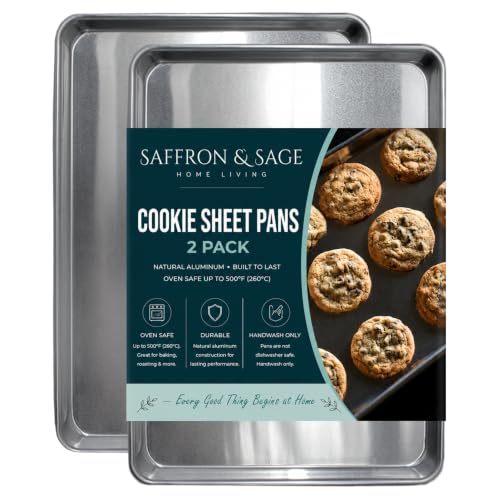
Unlike other pans for baking that are too thin and warp, or have a coating that peels and rusts, the Saffron & Sage baking tray is made out of a thick aluminum gauge with a reinforced steel rim to withstand temperatures of up to 500ºF / 260ºC without twisting or warping. Its metal surface has no teflon or other coatings added, therefore these half sheet pans will not peel or rust, making them long lasting.

Naturals bakeware is made of pure aluminum for superior heat conductivity and produces consistently evenly browned baked goods every time.
When Stainless Steel Is the Smarter Long-Term Investment
Stainless steel is the smarter long-term investment because it offers outstanding durability that often lasts a lifetime. Unlike aluminum, which may warp or scratch more easily, stainless steel resists rust, stains, and corrosion over decades of heavy use. Its uncoated surface prevents flaking, so you can cook confidently without worrying about peeling or chipping. You can also safely use metal utensils on it without damage, and the finishes—whether polished or brushed—maintain their sharp look for years. Cleaning is straightforward: toss it in the dishwasher or scrub vigorously without risking surface damage, thanks to its non-reactive, corrosion-resistant properties. High-quality 18/8 or 18/10 stainless steel won’t warp under high heat or leach chemicals into your food, making it safer and more reliable. While the initial cost is higher, stainless steel saves money in the long run by eliminating frequent replacements and maintaining performance under humid conditions or heavy daily usage.
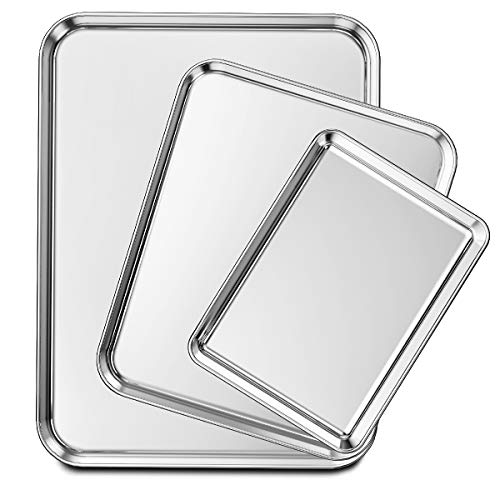
MORE WAYS TO USE: The stainless steel baking sheet set includes 3 different sizes of baking sheets which designed for high performance,15.8 x 12 x 1 inch, 12.25 x 9.65 x 1 inch, and 9.37 x 7 x 1 inch. A great replacement of aluminum pans, fits most regular toaster ovens, meet most of your daily baking or roasting needs, also good to be used as serving tray, cookie sheet and more

Versatile Three Size Combo:Your complete baking set includes three sizes at 17.5x13, 15.7x12, and 12.6x9.5 inches to cover every kitchen task from full sheet roasting to small batch cookies. The large pan fits standard ovens, the medium works with toaster ovens, and the compact size handles snacks and ingredient preparation
![Wildone Baking Sheet & Rack Set [2 Sheets + 2 Racks], Stainless Steel Cookie Pan with Cooling Rack, Size 16 x 12 x 1 Inch, Non Toxic & Heavy Duty & Easy Clean](https://m.media-amazon.com/images/I/4149WYoQCqL._SL500_.jpg)
Perfect Bundle: Including 2pcs baking sheet 16 x 12 x 1 inch and 2pcs cooling rack 15.35 x 11 x 0.67 inch, fits most regular oven and toaster oven. Our baking sheet pan and cooling rack are designed to work perfectly together and superbly apart