

Are you struggling to get consistent dough thickness every time you roll? Using guide rings can help you achieve that perfect, even layer without guesswork. These fixed spacers slide onto your rolling pin to set your dough to a precise half-inch thickness.
Making your baking more reliable and efficient is easier with these simple tools. Keep reading to see how they can improve your baking process.
What Are 1/2 Inch Guide Rings for Rolling Pins?
1/2 inch guide rings are the thickest standard size in set options, measuring approximately 12.6 mm to 12.7 mm. When you slide these rings onto the ends of your rolling pin, they serve as precise thickness spacers, allowing you to roll dough, fondant, or sugarpaste to an even 1/2 inch thickness every time. Their durability is important; you’ll find them made from tough plastic or silicone-like materials that withstand repeated use in the kitchen. Color coding helps you quickly identify the 1/2 inch ring among thinner options, such as 1/16 inch or 1/4 inch rings. These rings work by touching your work surface, preventing the rolling pin from compressing the material further, which keeps the dough or fondant level and ensures consistent results. Using guide rings for thicker applications offers a reliable way to achieve uniform thickness without guesswork, making your baking or decorating more precise and efficient. For achieving even results, you can apply the same principle of accurate weighing that top food scales use for meat portions. Just as pan size determines baking volume, these rings ensure your dough matches the recipe’s intended thickness for proper baking. For sourdough bakers, a quality loaf pan can similarly guarantee uniform dough height during proofing and baking.

Rolling Pin Rings: Ensure even dough thickness with these Geesta Designs Rolling Pin Bands create even thickness making homemade pasta, pizza, pie and tart dough, biscuits, cookies, crackers and more. (Fit Geesta Rolling Pin)
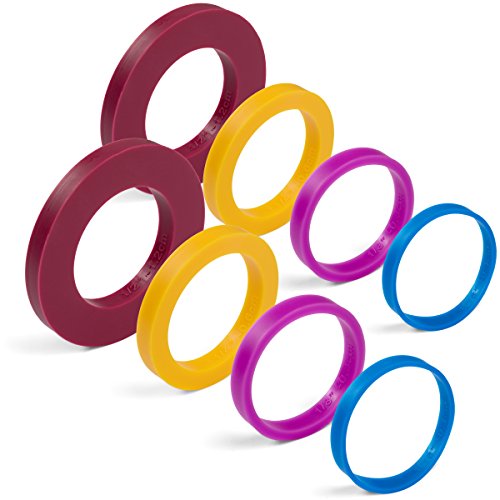
CREATE PERFECT BREADS & FOODS – Rolling pin spacers create even thickness making homemade pasta, pizza, pie and tart dough, biscuits, cookies, crackers and more.

[UNIVERSAL COMPATIBILITY] These rolling pin guide rings feature a 0.75" (19mm) center hole, specifically designed to be compatible with Joseph Joseph adjustable rolling pins. A perfect replacement or expansion set for your existing baking tools.
How to Check Compatibility With Your Rolling Pin
To check compatibility with your rolling pin, start by measuring the barrel’s diameter, not the handles. Your guide rings should match this measurement closely. Large rings fit pins around 44 mm in diameter, while small ones suit approximately 25 mm. Ensure your pin has a straight-sided barrel; tapered shapes can cause uneven contact and wobbling, making it harder for the rings to sit evenly. For example, the PME Large Rolling Pin Guide Rings are designed for pins with a diameter of 44 mm to ensure a precise fit. Check that there is enough open barrel area past the handles so the rings can slide on without obstruction. Material considerations are important: rigid rings made of smooth wood or stainless steel need a precise diameter match, while silicone or flexible bands can stretch slightly but still require a snug fit to stay in place. Test for smooth sliding to avoid dragging or sticking, especially with textured surfaces. Using heat resistant oven gloves can protect your hands when handling hot baking sheets after rolling. Lastly, confirm that your storage method—whether rings stored flat or in a bag—fits with your pin’s size and shape before making a purchase. A half sheet pan is similarly measured precisely to ensure even baking results, though it is not related to rolling pins. For those who also use a stand mixer, KitchenAid attachments often require similar precision in fit to guarantee optimal performance.
How to Use 1/2 Inch Guide Rings for Perfect Dough
To use 1/2-inch guide rings for perfect dough, slide one ring onto each end of your rolling pin, ensuring both sit evenly. This setup keeps the pin level during rolling, which is essential for consistent thickness. Place your dough on a lightly floured surface to prevent sticking. Roll from the center outward with short, controlled passes; the rings will stop the rolling pin at the exact 1/2-inch depth, eliminating guesswork. The rings are made from food-grade silicone and are BPA-free, ensuring safe and durable use. Unlike glass loaf pans, metal versions are more durable and conduct heat better for even baking. Springform pans are also available in various metal options for reliable baking performance. Choosing heat-resistant materials for your kitchen tools helps prevent burns during use.
If you’re accustomed to freehand rolling, these spacers provide reliable, repeatable thickness without constant checking. Watch the dough’s elasticity—if it springs back before reaching the guide rings, chill it briefly. This firms the dough, making it easier to roll out evenly. Periodically turn the dough to confirm both rings remain in contact. This ensures an even sheet and predictable results, leading to better baking outcomes every time.

CONSISTENT THICKNESS, EVERY TIME: Tired of dough that's too thin in the middle and too thick on the edges? These guide rings fix that. Slip a pair onto your rolling pin and roll once—perfectly even dough from end to end. No more burnt edges, no more raw centers.

Rolling Pin Rings — 1/2 inch rolling pin guide adjusts dough to your preferred thickness for easily making handmade pasta, pizza, pies, tarts, cookies, biscuits, crackers, and more. Perfect for consistent results every time

Mrs. Anderson’s Rolling Pin Rings lifts rolling pin ends equally to roll out dough into a consistent thickness that bakes without raw, doughy pockets
Best Recipes That Need 1/2 Inch Thick Dough
Biscuit dough should be rolled to a thickness of 1/2 inch, which is ideal for achieving tall, flaky layers. This precise thickness supports the structure needed for perfect biscuits, whether they’re made with buttermilk, cheddar, or bacon. Maintaining this measurement helps ensure the dough is sturdy enough to rise well without becoming dense or tough. Hamilton Beach stand mixer attachments can help you achieve this consistent thickness with ease when using a rolling pin guide. Using heavy glass mixing bowls for your dough ingredients keeps them properly chilled and stable during preparation. If you lack a rolling pin, a wine bottle can serve as an effective substitute for achieving even thickness in a pinch.
The key is to handle the dough gently—overworking it will develop gluten, resulting in tougher biscuits. Mix the ingredients just until combined to preserve flakiness. Use cold butter or bacon fat, which creates steam during baking and forms flaky layers. When cutting out biscuits, press straight down with your cutter rather than twisting; twisting seals the edges and prevents the biscuits from rising fully. For quick breads and tart pastries, this 1/2 inch thickness provides even baking, a soft interior, and proper consistency before final shaping. Stick to this guide, and your dough will bake consistently perfect results.

Stainless steel rolling pin with thickness rings: This 17-inch rolling pin is made from high quality stainless steel for superior durability and longevity. It resists rust far better than ordinary aluminium rolling pins, embossed rolling pin or tortilla roller. The sturdy and robust construction ensures it will last a long time even with frequent use. Compared to traditional dough roller such as a rolling pin and mat or silicone rolling pin, this rolling pin for dough will add durability to your baking needs.
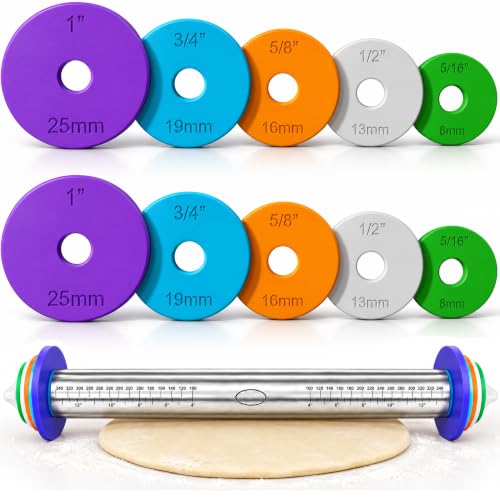
【10-Piece Set with 5 Thickness Options】Includes 10 rolling pin guide rings in 5 different sizes, with 2 matching rings per size. This set provides multiple thickness options for preparing cookie dough, pizza crusts, pie pastry, biscuits, and other baked goods

4 THICKNESS OPTIONS: 13 mm (1/2"), 16 mm (5/8"), 19 mm (3/4") or 25 mm (1") approximately.
Common 1/2 Inch Guide Ring Pitfalls to Avoid
To avoid common pitfalls with 1/2 inch guide rings, start by verifying that your rolling pin is compatible with the rings. Loose rings can slip off mid-roll, disrupting your rhythm and requiring you to restart. Soft rubber rings may also compress under pressure, causing your dough to become thinner than intended. Maintain steady, light pressure since the rings only control the minimum gap, not the total thickness. A high-quality food scale can help you verify dough weight for consistent results, just as precision rolling pin rings ensure uniform thickness. Be careful not to roll your dough wider than the rings’ span, as this will leave groove marks along the edges. Sticky dough can also cause trouble by grabbing the rings, resulting in drag and potential tearing. Regular maintenance of your guide rings is essential; nicks, cracks, or worn rings can reduce accuracy and lead to sanitation issues. Inspect them routinely and replace any damaged pieces promptly. If you rush the process, your dough may warp from heat, much like how cooling cake in the pan for too long can lead to a soggy bottom. Ensuring your guide rings closely match the diameter of your rolling pin will help you achieve consistent, reliable 1/2 inch thickness without unnecessary frustration. Choosing a rolling pin with a heat-resistant construction can prevent warping issues similar to those found in high-quality roasting pans.